Introduction
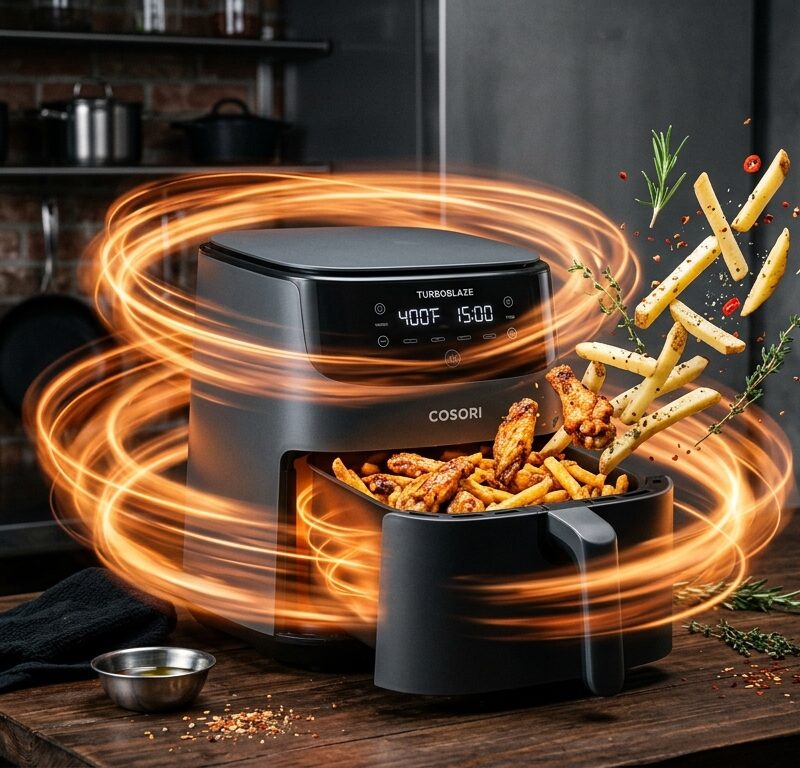
Air fryers keep expanding well past their original “crisp things with less oil” pitch, and the Cosori TurboBlaze shows just how far that shift has gone. Rather than sticking to a single crisping function, it’s built as a much broader countertop cooking tool — nine functions, a PFAS-free ceramic interior, and a genuinely wide temperature range aimed at more even, precise results. This article covers what the TurboBlaze actually offers, how its various functions tend to get used in a real kitchen, who it’s likely worth buying for, and a set of practical points worth weighing before it takes up a chunk of your counter.
As always with these breakdowns, this isn’t about crowning it the single best air fryer available. It’s a straightforward look at the specs and functionality so you can judge for yourself whether it fits how you cook.
Key Features
9-in-1 functionality. Nine cooking modes in total — air fry, roast, bake, broil, dry, frozen, proof, reheat, and keep warm — a considerably wider spread than what a basic air fryer offers on its own.
6-quart capacity. Sits comfortably in the mid-to-large range, generally enough for a small to medium household in one batch, or big enough for a moderately sized cut of meat or a full tray of vegetables.
PFAS-free ceramic coating. The basket uses a ceramic, PFAS-free coating instead of a traditional chemical nonstick finish, which matters considerably to anyone specifically avoiding PFAS in their cookware.
Wide temperature range (90°–450°F). That low end, starting at 90°F, opens up functions like proofing dough or dehydrating, while the 450°F ceiling supports more aggressive crisping and roasting than some air fryers can manage.
Precise heating for even results. Generally tied to how the heating element and airflow are engineered to distribute heat more evenly throughout the basket, aimed at addressing the common air fryer complaint of unevenly cooked food, especially near the edges.
Distinct named functions rather than generic settings. Having separate dry, proof, and keep warm modes, rather than folding everything into one generic “bake” or “air fry” setting, suggests more specific temperature and time programming behind each mode.
Standard 120V power. Runs on regular household current, so no special electrical setup is needed beyond a normal wall outlet.
How It Can Be Used
Air frying is the baseline crisping mode, used for fries, chicken wings, or frozen snacks, relying on hot air circulation to crisp things up with barely any added oil.
Roasting handles bigger cuts of vegetables or proteins that benefit from steady, even heat over a longer stretch, functioning a lot like a small oven.
Bake and broil push the unit further into oven-adjacent territory — bake for small casseroles or baked goods, broil for strong top-down heat to brown or finish a dish.
The dry function is generally used for dehydrating fruits, vegetables, or homemade jerky-style snacks, leaning on the lower end of the temperature range and a much longer cooking time than crisping or roasting would need.
The frozen setting is tailored specifically to cooking straight from frozen, adjusting time and temperature to account for how differently frozen food behaves compared to fresh or thawed ingredients.
Proof is a less common inclusion for this category and is generally used for proofing bread or pizza dough, relying on controlled, gentle warmth to help dough rise — usually the job of a dedicated proofing box rather than a standard air fryer.
Reheat and keep warm round things out — reheat for bringing leftovers like pizza or fried food back to something resembling their original texture, keep warm for holding already-cooked food at a safe, ready-to-eat temperature until serving.
Who It May Be Suitable For
Households wanting one appliance to cover multiple cooking tasks. Given the nine functions, this may particularly appeal to anyone hoping to consolidate an air fryer, small oven, dehydrator, and proofing box into a single countertop unit.
People who bake bread or work with yeasted dough. The dedicated proof function is a genuine standout feature here, relevant to home bakers who’d otherwise need a separate method for proofing.
Anyone specifically avoiding PFAS in cookware. Buyers who’ve made a deliberate choice to steer clear of PFAS-containing coatings may find this a meaningful differentiator from standard nonstick air fryers.
Small to medium households cooking moderate batches. The 6-quart capacity suits two to four people comfortably, or a reasonably sized single dish without needing multiple rounds.
Anyone who values consistency across a batch. The “precise heating for even results” emphasis suggests this could be a good fit for anyone burned by uneven cooking in a more basic air fryer before.
Households needing very large batches regularly, or anyone who only ever uses the basic air-fry function without interest in the other eight modes, might find the extra functionality here going unused, and a simpler, cheaper air fryer could cover their needs just fine.
Important Things to Consider
A real learning curve across nine functions. With this many modes, figuring out which setting suits which food takes some initial learning, especially for less typical functions like proof or dry.
Counter and storage space for a 6-quart unit. A mid-to-large capacity air fryer takes up meaningful counter space, worth measuring against your kitchen before committing, especially if space is tight.
Ceramic coating care over time. PFAS-free ceramic coatings are generally durable but can still be sensitive to metal utensils or abrasive cleaning tools, so following the manufacturer’s care instructions matters for preserving performance.
Not a full oven replacement for baking. The bake and roast functions add real versatility, but the smaller interior compared to a full oven means it isn’t a complete substitute for larger baking projects or big batches.
Preheat times when switching functions. Multi-function units like this may need preheat time when jumping between very different temperature ranges — say, moving from a proofing task straight to a high-heat roast — worth factoring into meal timing.
A consistent cleaning routine matters more with heavier use. More functions generally means more regular use, and correspondingly, more consistent cleaning is needed to prevent buildup, particularly for functions like dry or roast that can leave residue over repeated use.
Comparison of General Categories
Multi-function air fryers with baking and dehydrating capability — this category — aim to fold several small appliances into one unit, offering broader versatility at the cost of a more complex interface and bigger footprint than basic air fryers.
Basic single-function air fryers stick purely to crisping, generally simpler and more affordable for anyone who doesn’t need baking, proofing, or dehydrating capability.
Countertop convection ovens offer a bigger interior for baking sheets or larger dishes and often include many of the same functions (bake, broil, roast), generally at an even bigger overall size than a large air fryer like this.
Dedicated dough proofers are built solely around proofing, generally offering more consistent, purpose-built conditions for that specific task than a secondary proof function bundled into a multi-purpose appliance.
Dedicated dehydrators work the same way — built solely for dehydrating, generally with more surface area and airflow control tailored specifically to that task compared to a general air fryer’s dry setting.
Which category makes sense comes down to how many distinct cooking functions you’ll actually use regularly, available counter and storage space, and whether consolidating several appliances into one unit is worth the added interface complexity versus keeping single-purpose tools.
Frequently Asked Questions
How many cooking functions does the TurboBlaze include? Nine total: air fry, roast, bake, broil, dry, frozen, proof, reheat, and keep warm.
Is the interior coating free of PFAS chemicals? Yes, it uses a PFAS-free ceramic coating rather than a traditional chemical nonstick finish.
What temperature range does it support? 90°F to 450°F, with the lower end supporting proofing and dehydrating, and the higher end handling crisping and roasting.
Can it be used to proof bread dough? Yes, a dedicated proof function is included — a less common feature among air fryers, generally aimed at helping yeasted dough rise under controlled, gentle warmth.
How much food fits in the 6-quart basket? Generally enough for a small to medium household in one batch, or a moderately sized cut of meat or full tray of vegetables.
Does it need any special electrical setup? No, it runs on standard 120V household power, same as most kitchen appliances.
Is this a good replacement for a full-size oven? For a lot of everyday baking, roasting, and reheating tasks, sure — though its smaller interior means it’s not a full stand-in for large-batch or large-dish oven baking.
Conclusion
The Cosori TurboBlaze combines a wide range of functions — from basic air frying to less common inclusions like dough proofing and dehydrating — into a single 6-quart, PFAS-free ceramic-coated appliance. Its broad temperature range and emphasis on even heat distribution are aimed at fixing the inconsistency that’s a common complaint with more basic, single-function air fryers.
Whether it’s the right fit for your kitchen really comes down to how many of its nine functions you’d genuinely use, how much counter space you can spare, and how much value you place on consolidating multiple cooking tools into one appliance. For anyone wanting a versatile, higher-capacity air fryer that goes well beyond basic crisping, the TurboBlaze covers a lot of ground.